661 – 676 AD · Arabia & SyriaFrom caliphate to inheritance
In 661 AD Hasan, Imam Hussein's (peace be upon him) elder brother, made peace with Muawiya ibn Abi Sufyan to end the bloodshed between Muslims — remembered as the "Year of Unity". Hasan died of poison in Medina around 670. Ibn Sa'd and al-Baladhuri report that it was given by his wife Ja'da bint al-Ash'ath, and al-Baladhuri adds that she acted at Muawiya's instigation, though some historians, such as Ibn Kathir, doubted that part. Some years later Muawiya had his son Yazid acknowledged as heir — the first time the caliphate passed from father to son. Al-Tabari records that a delegation from Medina returned from Yazid saying he drank wine, played with dogs and neglected prayer, and Ibn Kathir describes him as given to pleasures and wine. Several sons of leading Companions refused to pledge, above all Imam Hussein ibn Ali (peace be upon him) and Abdullah ibn al-Zubayr.
April 680 AD · Medina"One like me does not pledge allegiance to one like him"
When Muawiya died, Yazid wrote to al-Walid ibn Utba, governor of Medina, ordering him to take the pledge of Imam Hussein (peace be upon him), Abdullah ibn al-Zubayr and Abdullah ibn Umar firmly, with no leniency. Al-Walid summoned Imam Hussein (peace be upon him) at night. Imam Hussein (peace be upon him) came with young men of his family and stationed them at the door: if you hear my voice raised, come in. Marwan ibn al-Hakam was sitting with the governor. Al-Walid told Imam Hussein (peace be upon him) of Muawiya's death and called on him to pledge to Yazid. Imam Hussein (peace be upon him) replied that a man like him does not pledge in secret — if at all, it must be before the people.
Marwan told al-Walid: if he leaves now without pledging, you will never have such a chance again — hold him; if he pledges, good, if not, strike off his head. Imam Hussein (peace be upon him) sprang up: "Son of al-Zarqa, will you kill me, or will he? By God, you lie and you sin." Then he turned to the governor:
"O governor, we are the household of prophethood, the source of the message, where the angels come and go; through us God began and through us He sealed. Yazid is a sinful man who drinks wine, kills souls God has made sacred, and openly flaunts his sin — and one like me does not pledge allegiance to one like him. But let morning come for us and for you, and let us see which of us is more worthy of the caliphate."
He left. Al-Walid refused Marwan's advice, saying he would not want everything the sun rises over, if the price were killing Imam Hussein (peace be upon him).
The Egyptian writer Abdel Rahman al-Sharqawi turned this scene into a famous moment of his play Hussein the Revolutionary: al-Walid tells him that all they ask is a single word, and then he may go in peace. Imam Hussein (peace be upon him) answers that a word is no small thing — by a word a man enters paradise, and by a word he is cast into hell; a word is a light that guides people, a fortress of freedom, a trust and a responsibility, and a man's honour is his word. How, then, could he sell his word to Yazid?
Two nights later, on 28 Rajab, Imam Hussein (peace be upon him) left for Mecca with his family.
Spring – summer 680 · Mecca & KufaThe letters of Kufa — and the fate of Muslim
Imam Hussein (peace be upon him) stayed in Mecca for months while letters poured in from the people of Kufa (in today's Iraq), inviting him to come. He sent his cousin Muslim ibn Aqil ahead, who wrote back that 18,000 had pledged. Yazid then made Ubaydullah ibn Ziyad governor of Kufa. Under his pressure the crowds melted away until Muslim was left alone. A woman named Tawʿa sheltered him; he was betrayed, fought, was captured, and was executed on the palace roof — together with his host Hani ibn Urwa.
September 680 · Leaving Mecca"Better to be killed outside it"
Ibn Abbas, Ibn Umar and others urged him not to go to Iraq. He set out just as the pilgrimage began, telling Ibn al-Zubayr — as al-Tabari records — that he would rather be killed outside Mecca than have its sanctity violated because of him. On the road he learned of Muslim's death. He told the Bedouins who had joined him along the way that they were free to leave; they did, and only those who had come with him from Arabia remained.
2 Muharram 61 AH · 2 October 680Al-Hurr, and the halt at Karbala
He was met by al-Hurr ibn Yazid with 1,000 horsemen, ordered to escort him to Ibn Ziyad. They were exhausted with thirst, and Imam Hussein (peace be upon him) had his men give water to the soldiers and their horses. Along the way he addressed them:
"Do you not see that truth is not acted upon, and falsehood is not forbidden?"
Escorted by al-Hurr, the caravan finally halted on a plain near the Euphrates called Karbala.
3 – 9 MuharramSiege and thirst
Umar ibn Sa'd arrived with 4,000 troops, and Ibn Ziyad sent more. Three days before the battle, 500 horsemen were posted at the river to cut Imam Hussein's (peace be upon him) camp off from the water. Imam Hussein's (peace be upon him) half-brother Abbas led a night sortie of 30 riders and 20 men on foot, fought past the guards and brought back full waterskins. Talks between Imam Hussein (peace be upon him) and Umar ibn Sa'd came to nothing. On the 9th, Shimr arrived with Ibn Ziyad's order: submit to his judgment, or fight.
The night beforeThe last night
Imam Hussein (peace be upon him) asked for one more night. He gathered his companions and released them: night has covered you, he said — use it, for they want no one but me. Abbas answered first, then the family, then the companions — Muslim ibn Awsaja, Sa'd ibn Abdullah, Zuhayr ibn al-Qayn — none would leave. They spent the night in prayer.
10 Muharram · Ashura · 10 October 680The day of loyalty
After dawn prayer Imam Hussein (peace be upon him) drew up his men: 32 horsemen and 40 on foot. He addressed the army, reminding them of his descent from the Prophet. Then al-Hurr rode over to Imam Hussein's (peace be upon him) side, regretting what he had done. Imam Hussein (peace be upon him) told him: you are free (hurr), as your mother named you, in this world and the next. Al-Hurr fought until he was killed.
The companions fell one by one: Muslim ibn Awsaja, Habib ibn Mazahir, Zuhayr ibn al-Qayn. At noon Abu Thumama al-Saidi reminded Imam Hussein (peace be upon him) of the prayer, and he led those still standing in the prayer of danger as the arrows fell.
MiddayThe family
Then the Prophet's family went out. The first of them to fall was Ali al-Akbar, Imam Hussein's (peace be upon him) son; then Qasim, son of Hasan — a boy whom an eyewitness described as having a face like a sliver of the moon. Abbas fell too, with his full brothers Abdullah, Uthman and Ja'far.
Imam Hussein (peace be upon him) sat with his small son Abdullah in his lap. A man of the Banu Asad shot an arrow and killed the child; Imam Hussein (peace be upon him) caught his blood in his palm.
AfternoonThe fall
Alone, Imam Hussein (peace be upon him) kept fighting, charging those around him until they scattered. Then they closed in under Shimr. Zur'a ibn Sharik struck him, Sinan ibn Anas speared him, and he fell; his head was cut off. Umar ibn Sa'd ordered ten horsemen to ride over his body, and the tents were plundered. His son Ali (Zayn al-Abidin) was spared because he was ill. Seventy-two men had died with Imam Hussein (peace be upon him).
After KarbalaZaynab, and the road to Arbaeen
The heads, the women and the children were taken to Kufa. When the governor gloated, Imam Hussein's (peace be upon him) sister Zaynab answered him firmly: God had honoured them through His Prophet, and it is the wrongdoer who stands exposed — not them. In Damascus, at Yazid's court, she faced down a Syrian who asked for one of Imam Hussein's (peace be upon him) daughters, telling him that was not his right — nor Yazid's. Yazid later sent the family back to Medina.
Even the Kaaba was not spared under Yazid. In 683 AD his army under al-Husayn ibn Numayr besieged Mecca; the Kaaba was struck by catapults and caught fire. The army withdrew only when news of Yazid's death arrived.
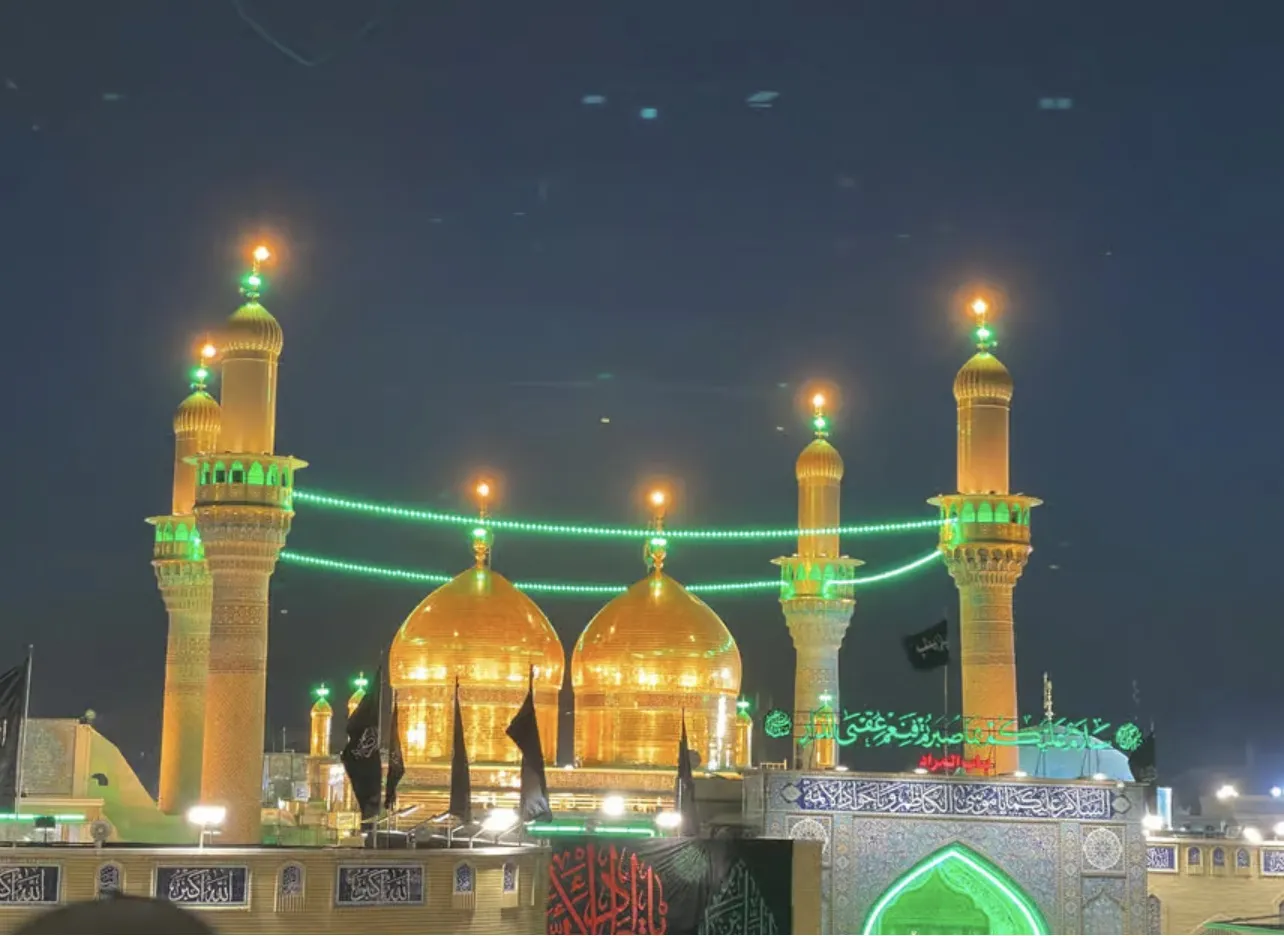
Imam Hussein (peace be upon him) was buried where he fell. His grave has drawn pilgrims ever since, the city of Karbala grew around it, and today millions walk there every year for the Arbaeen.
Sheikh Abdul Zahra Al-Kaabi was a preacher from Karbala, born around 1909. On Ashura in 1959 he recited the Maqtal beside Imam Hussein's (peace be upon him) shrine, and it was broadcast on Baghdad radio across Iraq and the Gulf. Ever since, his voice has been the sound of Ashura morning in Iraqi homes — decades after his death, no one has managed to imitate his style.
Na'i (lament) is a centuries-old Iraqi art of telling Imam Hussein's (peace be upon him) story: a narrated recitation in a mournful melody, with no musical instruments, blending classical Arabic prose with folk elegy verses. Its purpose is not to entertain but to make listeners feel present in Karbala. You don't need to understand Arabic — the voice carries the story, and the subtitles do the rest.
The video presents the complete Maqtal (1.5 hours) over real images of Karbala, with English and Russian subtitles.