At a glance
- Where
- Babylon, near Hilla, about 85 km south of Baghdad
- Built
- Around 575 BC under Nebuchadnezzar II
- Dedicated to
- Ishtar, goddess of love and war
- Excavated
- 1902–1914, German expedition led by Robert Koldewey
- Time needed
- At least 1 hour (2–3 hours for all of Babylon)
- Best season
- October to April
Few monuments of the ancient world are as instantly recognisable as the Ishtar Gate of Babylon: a wall of deep blue glazed bricks, crossed by rows of golden bulls and strange serpent-dragons. Most people have seen it in photographs from a museum in Berlin. Far fewer know that you can still stand at the place where it was built, in Babylon in central Iraq, and see parts of the original gate that never left the ground.
This guide explains what the Ishtar Gate was, what happened to it, what you can see of it at Babylon today and how to fit a visit into a trip to Iraq, with the tips I share with the travellers I bring to the site.
What was the Ishtar Gate of Babylon?
The Ishtar Gate was the grand northern entrance to the inner city of Babylon. It was built around 575 BC on the orders of Nebuchadnezzar II, the king who turned Babylon into one of the largest and most splendid cities of its time. The inner city had eight gates, each named after a god, and this one was dedicated to Ishtar, the goddess of love and war.
It was not only a doorway. The gate was a statement of power and faith, the first thing a visitor, an ambassador or a religious procession would see when entering the heart of the capital. Through it passed the Processional Way, the sacred road that led towards the temple of Marduk, the chief god of Babylon.
Bulls, dragons and lions: reading the walls
What makes the Ishtar Gate unforgettable is its decoration. The walls were faced with bricks covered in a shining blue glaze, a colour that recalled precious lapis lazuli. On this blue background, craftsmen set animals moulded in relief and glazed in yellow, brown and white, arranged in long alternating rows.
The bull of Adad
The bulls, often described as aurochs, a wild ox now extinct, were the animal of Adad, the god of storms and rain. In a land that lived from its rivers and its harvests, he was a god people took very seriously.
The mušḫuššu of Marduk
The second animal is the most striking: the mušḫuššu, a creature with a scaly body, a serpent's head and tongue, the front legs of a lion and the back legs of a bird of prey. It was the sacred beast of Marduk. Children who visit Babylon usually call it "the dragon", and that is not far from the truth.
The lions of Ishtar
Along the walls of the Processional Way, leading up to the gate, walked rows of glazed lions, the symbol of Ishtar herself. Together, bulls, dragons and lions formed a kind of guard of honour of the gods for everyone who entered the city.
Nebuchadnezzar also left a long cuneiform inscription describing the work. In it, the king explains that he rebuilt the gate, decorated it with blue bricks and figures of bulls and dragons, and roofed it with cedar, so that people would gaze at it in wonder. Nearly 2,600 years later, they still do.
From Babylon to Berlin: the gate's journey
For centuries the gate lay buried under the ruins of Babylon. Between 1902 and 1914 a German expedition led by the architect and archaeologist Robert Koldewey excavated the area and recovered a huge number of glazed brick fragments. These were shipped to Germany, sorted and pieced together over many years.
The result is the famous reconstruction in Berlin's Pergamon Museum, unveiled in 1930, which shows the smaller front section of the gate together with part of the Processional Way. The museum has been closed for a long renovation, with a phased reopening announced, so check its official website before planning a visit. Single panels of lions, bulls and dragons are also displayed in several other museums around the world, including in Istanbul, Paris and New York.
What you can see of the Ishtar Gate in Babylon today
The blue replica at the entrance
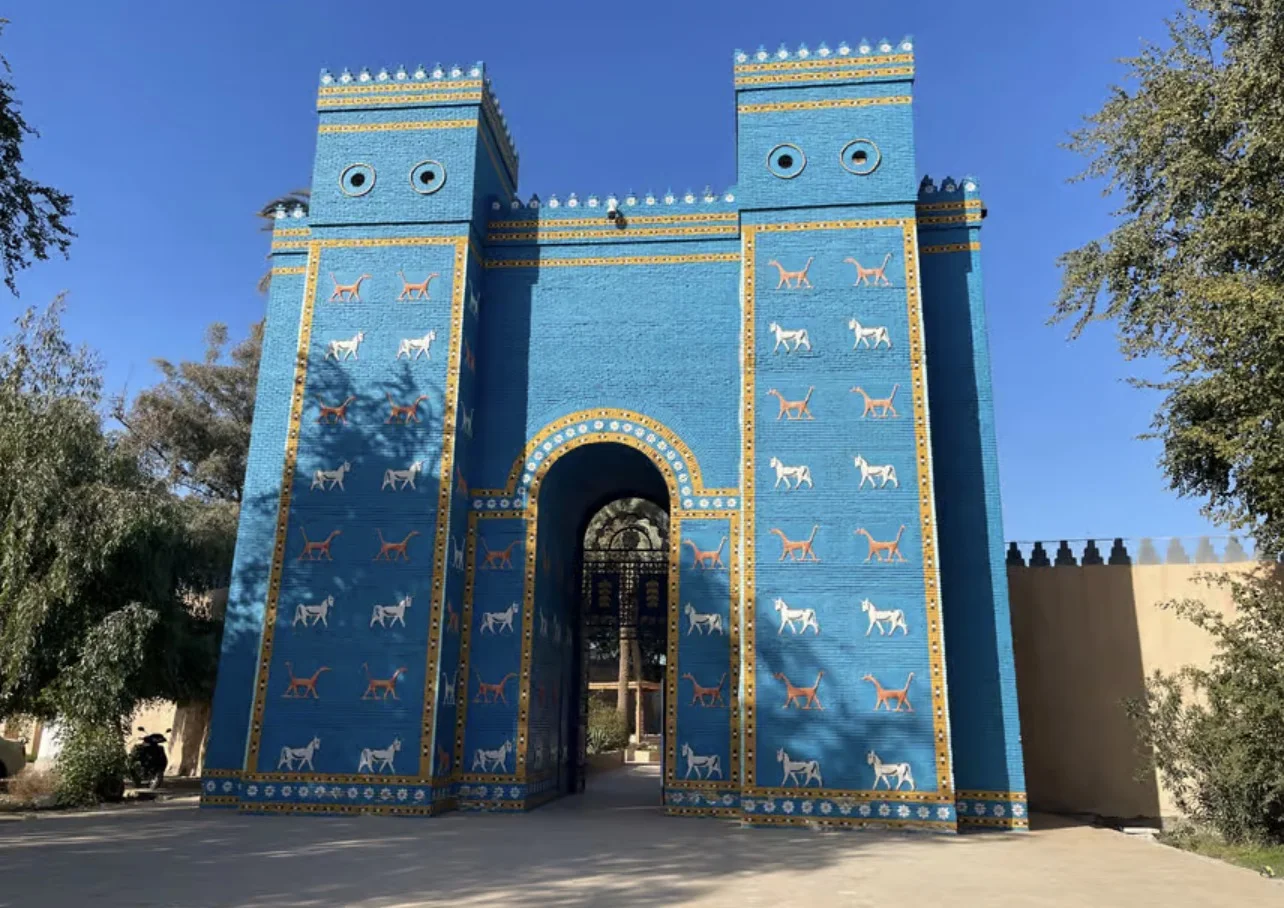
When you arrive at the archaeological site of Babylon, near the city of Hilla, the first thing you notice is a bright blue gate with rows of animals: a smaller modern replica of the Ishtar Gate. It is not ancient, but it is perfect for understanding the colours and the rhythm of the original decoration, and on a sunny day, with the blue sky behind it, it is one of the most photographed spots in Iraq.
The original foundations, still in place
The real treasure lies a little further on. The gate was rebuilt and raised several times, and its lower levels, made of unglazed bricks, stayed underground when the upper parts were taken away. Today you can walk down between these original walls and see dozens of bulls and dragons in relief, standing exactly where Nebuchadnezzar's builders placed them. They are the colour of earth rather than blue, but touching them is a direct link to the Babylon of the 6th century BC.
The Processional Way
From the gate you can follow part of the Processional Way, the road along which the statues of the gods were carried during the New Year festival, the Akitu. Imagining the music, the crowds and the glazed lions on both sides is easy once you stand there.
For the rest of the site, including the Lion of Babylon, the Southern Palace and the base of the great ziggurat, see my complete guide to visiting Babylon.
How to get to the Ishtar Gate from Baghdad
Babylon lies about 85 km south of Baghdad, roughly an hour and a half by car depending on traffic. There is no practical public transport for tourists to the site, so most visitors come by private car with a driver or on an organised tour. On the way you will pass routine checkpoints; keep your passport at hand.
The Ishtar Gate area is right at the start of the visit, so it is the natural first stop before you continue into the rest of the ruins.
Best time to visit
The most comfortable months are October to April, when days are mild and the light is soft. In summer temperatures often climb above 45 °C, so if you travel then, arrive as early as possible. For photographs, the morning sun lights the blue replica beautifully, while the reliefs in the original foundations show their details best when the sun is not straight overhead.
Allow at least an hour for the gate, the foundations and the Processional Way, and two to three hours for the whole of Babylon.
Practical tips
- Tickets: sold at the site entrance. Prices can change, so carry some cash in Iraqi dinars.
- Shoes and sun: the ground is uneven and there is little shade. Bring a hat, sunscreen and water.
- Look down, not only up: many visitors photograph the blue replica and leave. The original reliefs in the foundations are the part you will remember.
- Before or after Berlin: if you have seen the reconstruction in Berlin, Babylon shows you its original setting; if you visit Babylon first, Berlin will feel like meeting an old friend.
- Visa: entry rules for Iraq change from time to time, so check the latest official information for your nationality before booking.
The Ishtar Gate on an Iraq itinerary
A visit to the Ishtar Gate fits naturally into a day in Babylon, which can be combined with the shrine cities of Karbala and Najaf further south. On our 7-day Iraq heritage tour Babylon comes early in the trip, right after Baghdad, and it is often where travellers first feel the depth of Mesopotamian history. After Babylon, many continue to Najaf to visit the Imam Ali Shrine. The 9-day tour adds the north as well.
At the gate I always stop the group in front of one particular dragon in the foundations. Its tongue, its claws, even the curl of its tail are still sharp after more than two and a half thousand years. That is the moment people stop taking photos and just look. — Saif
Frequently asked questions
Is the original Ishtar Gate in Babylon or in Berlin?
Both, in a way. The glazed front section was reconstructed in Berlin's Pergamon Museum, while the original unglazed foundations with bull and dragon reliefs remain in place at Babylon.
Is the blue gate at Babylon original?
No. The bright blue gate at the entrance of the site is a smaller modern replica. The ancient parts are the foundations a short walk away.
What animals are on the Ishtar Gate?
Bulls, sacred to the storm god Adad, and the mushhushshu dragon of Marduk. Glazed lions, the symbol of Ishtar, lined the Processional Way leading to the gate.
How far is the Ishtar Gate from Baghdad?
Babylon is about 85 km south of Baghdad, around an hour and a half by car depending on traffic.
When is the best time to visit?
October to April, when the weather is mild. In summer, visit early in the morning.
Do I need a visa to visit Iraq?
Entry rules change from time to time. Check the latest official information for your nationality before booking your trip.

Saif Al-Tamimi is a Baghdad-based tour guide and the founder of Fable Tour. He guides travellers from all over the world through Iraq's archaeological sites and cities, in English, Russian and Arabic.